
Organic photovoltaics, encompassing organic solar cells (OSCs) and organic photodetectors (OPDs), have garnered significant attention due to their light weight, large-area processability, and mechanical flexibility. To date, OSCs achieve power conversion efficiencies (PCEs) exceeding 21%, while self-powered OPDs have demonstrated high detectivities >1013 Jones in the near infrared region. Beyond photoactive materials, synergistic advances in hole and electron transport layers (HTLs and ETLs) also play a decisive role in realizing these milestones. Owing to the distinct operational regimes of OSCs and OPDs, the key requirements for their HTLs diverge. In OSCs, HTLs serve to elevate the anode work function (WF) by eliminating the energy barrier, thereby facilitating efficient hole extraction. In OPDs, the HTLs should additionally create an energy barrier to suppress reverse electron injection. Consequently, developing multifunctional HTLs to reconcile these demands presents fundamental challenges. Phosphonic acid-based self-assembled molecules (SAMs) have emerged as rival HTLs to PEDOT:PSS owing to their minimal material usage, reduced parasitic absorption, and wide substrate compatibility, and their performance is fundamentally governed by the structures of π-conjugated headgroups. The classic carbazole (Cz) headgroup has been widely employed due to its planar backbone and the propensity to enable parallel packing; however, its weak electron-donating ability hinders the occurrence of strong intramolecular charge transfer, and inappropriate functionalization can lead to distorted or antiparallel molecular stacking, thereby eroding interfacial uniformity. In contrast, the dithieno[3,2-b:2',3'-d]pyrrole (DTP) unit enables stronger dipole–dipole and sulfur-mediated noncovalent interactions, thereby promoting denser and more ordered molecular packing, which offers a new avenue for constructing high-performance SAMs.
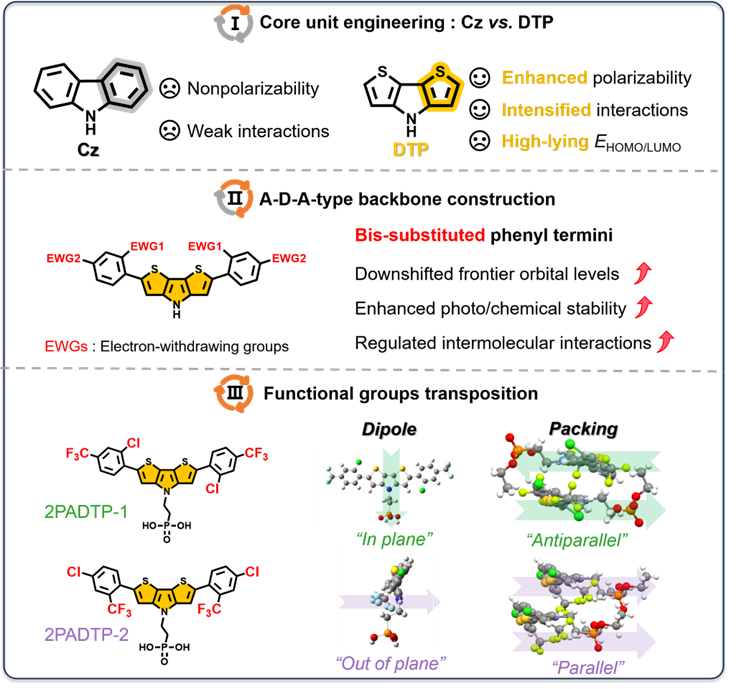
Figure 1.Molecular design principles. The design of novel SAMs for organic photovoltaics through concise core unit engineering, A–D–A-type backbone construction, and functional group transposition.
Herein, we report, for the first time, efficient DTP-based HTLs for organic photovoltaics, enabled by a regioisomeric engineering strategy: A-D-A type SAMs are constructed with a central DTP core flanked by polysubstituted phenyl termini bearing trifluoromethyl (CF3) and chlorine (Cl). Compared with direct DTP functionalization, the phenyl termini are readily pre-functionalized without disrupting the rigid planar backbone and π–π stacking; the synergistic action of CF3 and Cl enables more efficient downshifting of frontier molecular orbitals, and simply swapping the ortho-/para-positions of CF3 and Cl on the phenyl termini switches molecular stacking from disordered antiparallel to well-ordered parallel. Single-crystal analysis confirms that this positional exchange significantly alters the intermolecular noncovalent interaction network and crystal density, enabling the optimized molecule to assemble into a denser, smoother interlayer on ITO with more homogeneous surface potential, which effectively passivates interfacial defects, elevates the work function, and establishes a quasi-Ohmic p-type contact. Meanwhile, it templates the overlying PM6:Y6 bulk heterojunction for enhanced crystallinity, tighter π–π stacking, and favorable vertical phase separation, thereby synergistically suppressing recombination, reducing energy losses, and accelerating carrier extraction. This work not only elevates DTP as a competitive alternative against carbazole for SAMs, but also establishes functional group transposition as a finely tuned molecular lever, offering a new design concept for anode hole-transport interfacial molecular materials in organic photovoltaics.
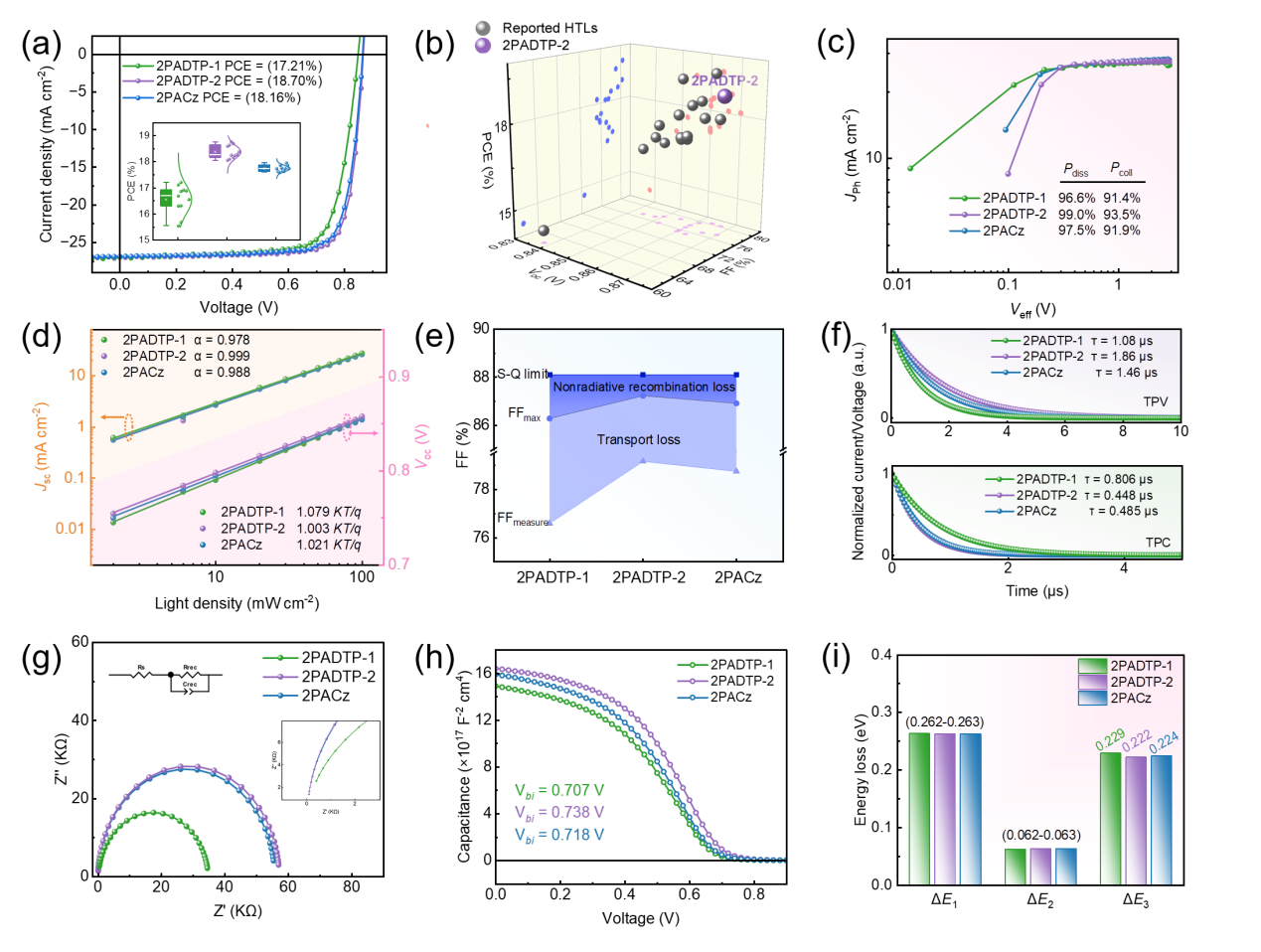
Figure2. Application of the SAM-based HTLs in OSCs and charge carrier dynamics
In terms of device performance, the optimized molecule 2PADTP-2 achieves a PCE of 18.70% and a fill factor exceeding 80% in the PM6:Y6 benchmark system, one of the best results for the PM6:Y6 system. This molecule exhibits strong universality across systems and great potential for scalable fabrication: a PCE of 20.92% is achieved in the D18:L8-BO:BTP-eC9 ternary system, and large-area devices (0.6 cm2) based on PM6:L8-BO:BTP-eC9 still deliver a PCE of 19.11%, the operational stability of the devices is markedly enhanced, with aT80 lifetime of 877 h, far superior to the control systems. In terms of organic photodetectors, the 2PADTP-2-based devices with PM6:Y6 exhibit significantly reduced dark current, a shot-noise-limited specific detectivity (D*sh) exceeding 1014 Jones over the 340–915 nm range with a maximum value of 6.52×10¹⁴ Jones at 805 nm, and markedly improved response speed and linear dynamic range as well as excellent thermal stability, representing one of the best results for PM6:Y6-based OPDs.
The research findings were published in Advanced Materials under the title "Functional Group Transposition Enables Antiparallel–Parallel Packing Switching in Dithieno[3,2-b:2′,3′-d]pyrrole Self-Assembled Molecules for Efficient Organic Photovoltaics." The first authors of the paper are Huayi Liu, a master student, Junjie Wen and Bo Yan, doctoral students, from the Beijing Advanced Innovation Center for Soft Matter Science and Engineering, Beijing University of Chemical Technology, and Lingyan Sun, a doctoral student from the Key Laboratory of Green Chemistry and Technology of Ministry of Education, Sichuan University. The corresponding authors are Professor Yao Liu and Associate Professor Wenxu Liu from Beijing University of Chemical Technology, and Professor Hyunbok Lee from Kangwon National University, South Korea. This work was supported by the National Natural Science Foundation of China, the Beijing Natural Science Foundation, and the High-Performance Computing Platform of Beijing University of Chemical Technology.
Article Information:
Liu, J. Wen, B. Yan, et al., “Functional Group Transposition Enables Antiparallel-Parallel Packing Switching in Dithieno[3,2-b:2′,3′-d]pyrrole Self-Assembled Molecules for Efficient Organic Photovoltaics. Advancced Materials. DOI: 10.1002/adma.75446
Original article link:

