
Photodynamic therapy (PDT) is regarded as a promising cancer treatment strategy owing to its non-invasiveness, high spatiotemporal selectivity, and low systemic toxicity. However, the classical Type II photosensitizers widely used in both clinical practice and research rely primarily on energy transfer to generate singlet oxygen (1O2), making their therapeutic efficacy heavily dependent on oxygen concentration. Because solid tumors generally feature a severely hypoxic microenvironment, 1O2 generation is inherently limited, while the photodynamic process itself further consumes oxygen, aggravating local hypoxia and driving tumor resistance and metastasis. Moreover, reductive metabolites such as NADH, which accumulate in tumor cells, continuously scavenge reactive oxygen species (ROS), further undermining treatment. Overcoming this oxygen dependence and achieving a precise switch from the classical Type II pathway to a hypoxia-tolerant Type I mechanism thus remains a central scientific challenge in PDT.
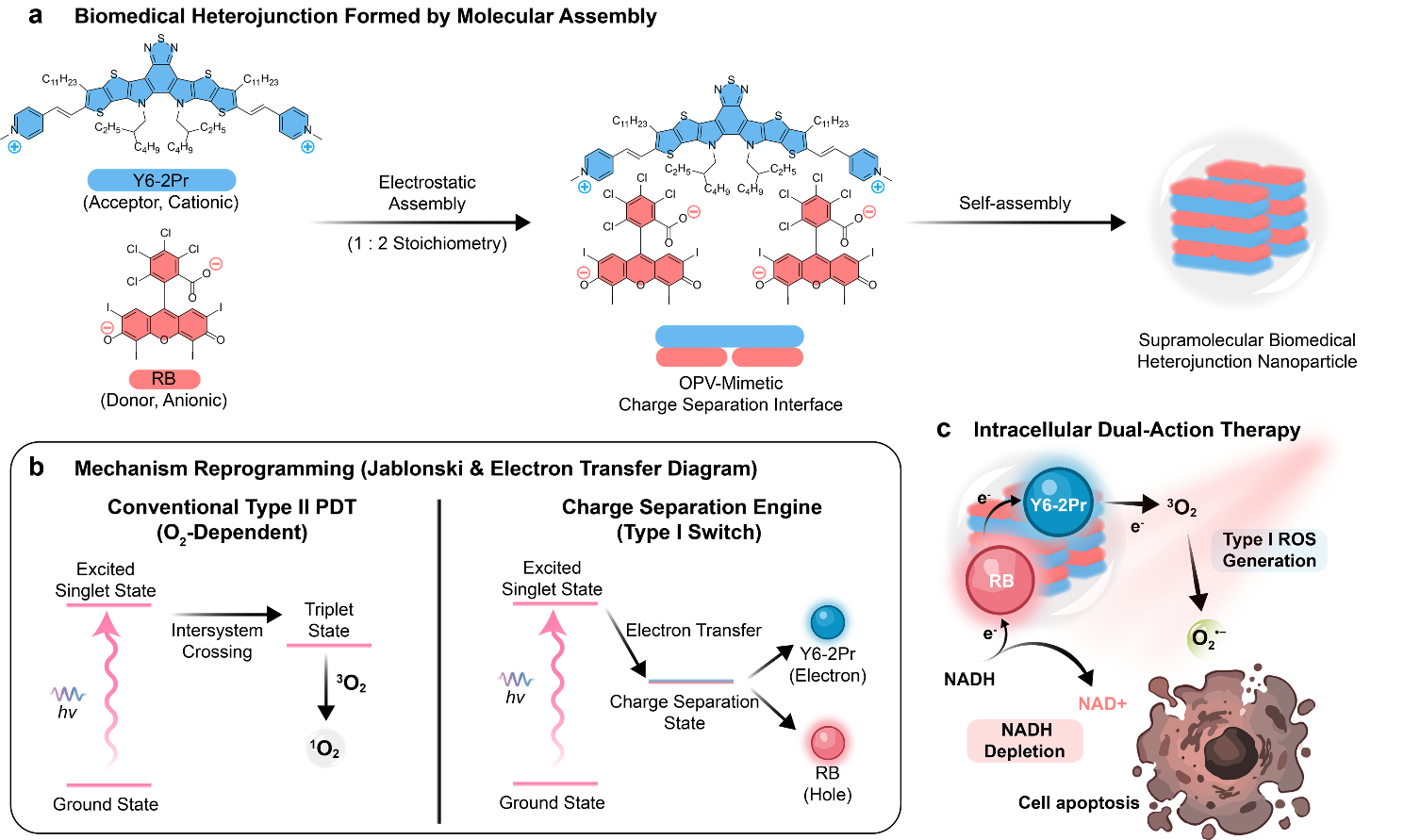
Recently, the Peng group at Beijing University of Chemical Technology developed a "Biomedical Heterojunction" inspired by organic photovoltaics. Through electrostatic self-assembly of the cationic acceptor Y6-2Pr and anionic photosensitizer Rose Bengal (RB), the team constructed a well-defined donor–acceptor heterojunction with 1:2 stoichiometry. This strategy successfully converts the energy-transfer-dominated Type II process into an electron-transfer-dominated Type I mechanism.The heterojunction exhibits a binding constant of 3.06 × 10⁶ M-1 and a donor–acceptor distance of ~5.3 Å. Femtosecond transient absorption spectroscopy reveals ultrafast electron injection from RB to Y6-2Pr within ~409 fs, forming a charge-separated state and dramatically shortening the RB triplet lifetime from ~93.8 μs to 58.78 ns. EPR and ROS assays confirm markedly enhanced superoxide anion radical (O2•) production alongside suppressed singlet oxygen generation.Crucially, photogenerated holes continuously oxidize intracellular NADH, establishing a “NADH → heterojunction → O2” photoredox cycle that depletes reductive metabolites while sustaining superoxide generation. This dual synergistic mechanism maintains excellent photodynamic activity even under hypoxia. In 4T1 tumor-bearing mice, the nanoscale heterojunction achieved a tumor inhibition rate of 95.47% under white-light irradiation with favorable biosafety.This work introduces interfacial charge separation from organic photovoltaics into photomedicine, providing a new molecular design strategy for next-generation hypoxia-tolerant Type I photodynamic systems.
The work, titled “Reprogramming Photosensitization Mechanisms for Hypoxic Tumor Therapy via Organic Photovoltaic-Inspired Heterojunctions,” was published in Angewandte Chemie International Edition.
Article information: Shirong Yan, Lu Qiao, Wu-Jie Guo, Shihao Xu, Tongfei Qi, Ben Zhong Tang*, Hui-Qing Peng*. Reprogramming Photosensitization Mechanisms for Hypoxic Tumor Therapy via Organic Photovoltaic-Inspired Heterojunctions. Angew. Chem. Int. Ed. 2026, 65, e9966547.
Link: https://doi.org/10.1002/anie.9966547

