
Organic solar cells (OSCs) have attracted extensive attention due to their outstanding advantages, including a wide range of material choices, lightweight device nature, and low-cost large-area solution processability. To date, their power conversion efficiencies (PCE) have been reported to exceed 21% in the literature. In high-performance OSCs, an electron transport layer (ETL) is typically inserted between the cathode and the active layer to mitigate the Schottky barrier arising from the work function (WF) mismatch between the metal electrode and the active layer. However, with the rapid development of near-infrared fused-ring electron acceptors (FREAs), their deeper frontier molecular orbital energy levels impose higher requirements on the energy level matching of interlayers. Meanwhile, traditional donor-acceptor (D-A) type interlayers suffer from strong near-infrared parasitic absorption and rapid performance degradation under thick-film conditions, which have become core bottlenecks restricting the commercialization of OSCs.
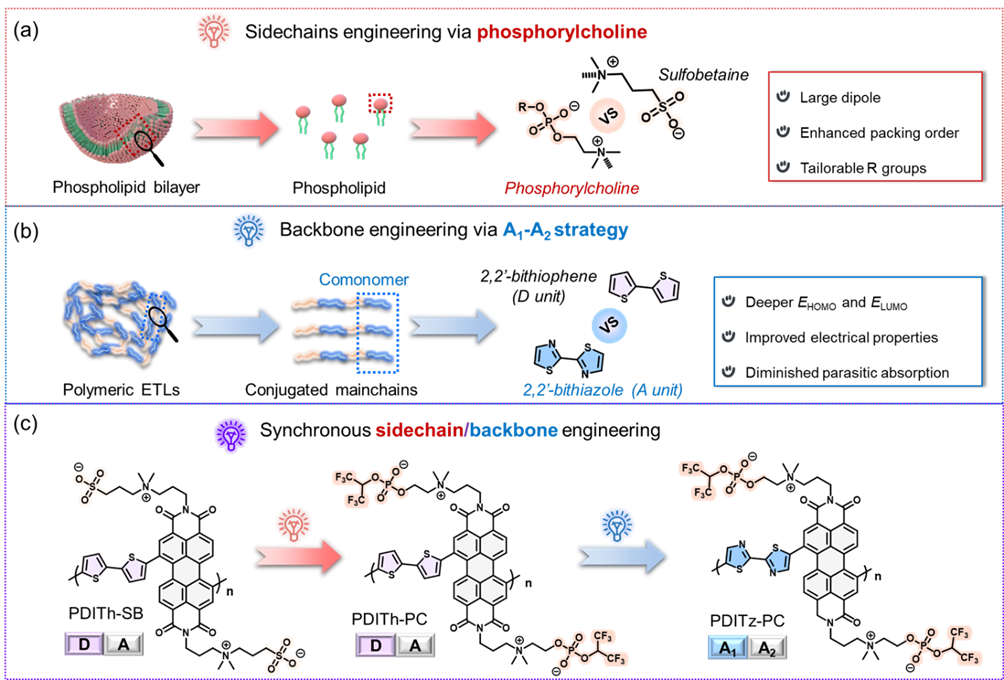
Figure 1.Design of bioinspired zwitterionic A1-A2 type electron transport layers via synchronous side chain and backbone engineering
In this work, the classic sulfobetaine (SB) side chain-functionalized D-A type zwitterionic material PDITh-SB was used as the reference material. Side chain modification was first performed by replacing SB groups with hexafluoroisopropyl-functionalized phosphorylcholine (PC) groups, yielding the intermediate material PDITh-PC. The introduction of hexafluoroisopropyl-functionalized PC side chains significantly enhances intermolecular interactions, greatly improves material hydrophobicity, and precisely regulates molecular packing behavior, creating structural conditions for the synergistic improvement of device PCE and long-term stability. Subsequently, the electron-donating 2,2'-bithiophene (BTh) unit in the backbone was replaced with the electron-deficient 2,2'-bithiazole (BTz) unit, leading to the design and synthesis of a novel A1-A2 type electron transport layer PDITz-PC. Through the synergistic regulation of bioinspired PC side chains and A1-A2 conjugated backbone, PDITz-PC not only fully meets the core basic requirements of ETLs, including solvent orthogonality, efficient WF modulation of Ag electrodes, significant enhancement of device built-in potential (Vbi), and higher electron mobility and electrical conductivity, but also endows the material with multiple key advantages: deeper frontier energy levels, lower near-infrared parasitic absorption, more ordered molecular packing, stronger moisture resistance, and excellent interfacial compatibility with mainstream active layer systems, providing an ideal interfacial solution for the fabrication of high-performance OSCs.
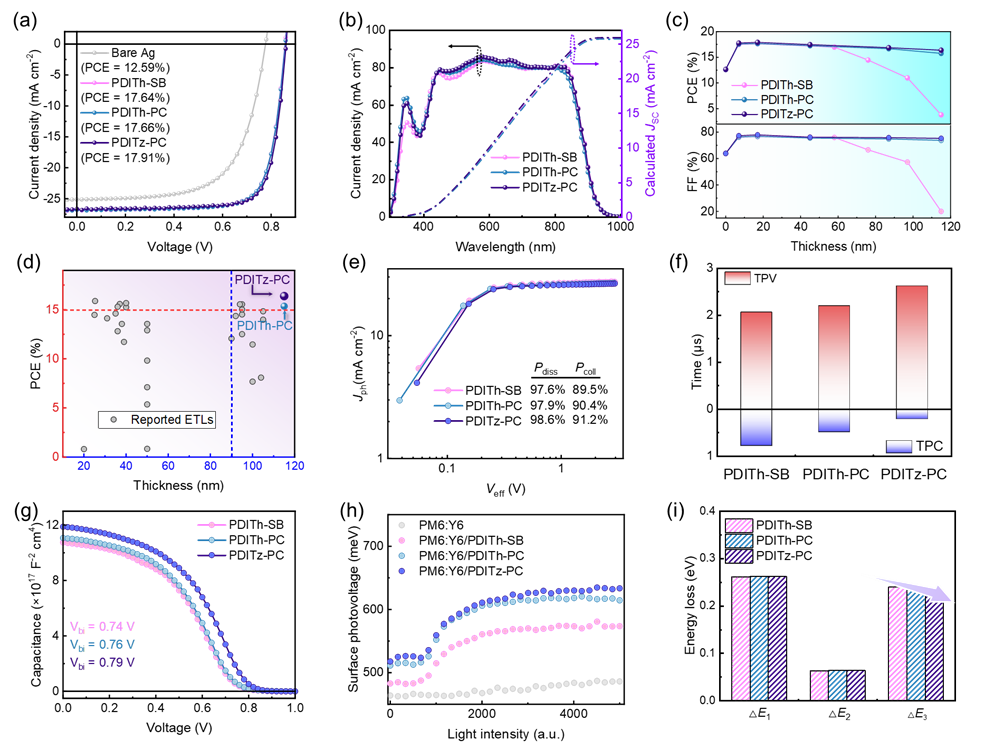
Figure 2. Photovoltaic performance characterization of organic solar cells based on PDITh-SB, PDITh-PC and PDITz-PC
At a thick film thickness of 115 nm, the performance of PDITh-SB-based devices degraded drastically, with severely distorted S-shaped J-V curves, indicating complete failure of charge transport. In sharp contrast, devices based on 115 nm thick PDITh-PC and PDITz-PC films maintained excellent performance: their PCEs retained 87% and 92% of their PCEmax. Notably, the PCE of PDITz-PC is among the best reported values for the PM6:Y6 system with ETL thickness exceeding 100 nm. Furthermore, PDITz-PC exhibits excellent system universality and scalable fabrication potential. When applied to the D18:L8-BO:BTP-eC9 ternary system, a small-area (0.04 cm2) device achieved a PCE of 21.02%; in the PM6:L8-BO:BTP-eC9 ternary system, a large-area (0.6 cm2) device delivered a PCE of 19.61%. In addition, devices incorporating PDITz-PC showed significant improvements in both shelf stability (T90>67 days) and operational stability (T80>1200 h). This study demonstrates that synergistic modification of molecular backbones and side chains holds great potential for the synthesis of high-performance charge transport materials for practical applications.
This research was published in Journal of the American Chemical Society under the title "Zwitterionic Bioinspired Acceptor–Acceptor (A1–A2) Type Interlayers for Organic Solar Cells". The co-first authors are Wentian Han, Junjie Wen, Yongkang Jiang from Beijing University of Chemical Technology, and Prof. Lulu Fu from Tianjin University of Science and Technology. The corresponding authors are Prof. Yao Liu and Assoc. Prof. Wenxu Liu from Beijing University of Chemical Technology, and Assoc. Prof. Xin Zhang from the University of Chinese Academy of Sciences. This work was supported by the National Natural Science Foundation of China and other projects.
Article Information:
Han W., Wen J., Jiang Y., et al. Zwitterionic Bioinspired Acceptor–Acceptor (A1–A2) Type Interlayers for Organic Solar Cells. Journal of the American Chemical Society. DOI: 10.1021/jacs.6c00049
Original Article Link:
https://doi.org/10.1021/jacs.6c00049

