
The continued advancement of lighting and display technologies relies heavily on the innovation and application of new luminescent materials. Owing to their environmental friendliness, solution processability, tunable emission spectra, and high photoluminescence efficiency, fluorescent carbon dots (CDs) have shown great promise for next-generation solid-state lighting and flat panel displays. CDs are typically synthesised via hydrothermal methods, exhibiting excellent solubility in water and alcohols. However, owing to the lack of suitable alcohol-soluble host materials, aqueous/alcohol-soluble CDs have so far failed to achieve electroluminescence. Most researches have relied on oil-soluble CDs synthesised through solvothermal methods to match host materials developed for organic light-emitting diodes (OLEDs), with devices fabricated using halogenated organic solvents. This strategy inevitably sacrifices the water/alcohol solubility of CDs, thereby limiting their performance and their potential for environmentally friendly processing. Therefore, there is an urgent need to develop alcohol-soluble host materials with efficient charge transport and green processability.
To address this challenge, a research team from Beijing University of Chemical Technology designed and synthesised the first alcohol-soluble bipolar host material, 2PCT, which was developed by introducing diethyl phosphonate (DEP) groups into a carbazole-triazine framework. This molecular design enhances π conjugation between the carbonyl moieties of the DEP groups and the carbazole unit, thereby promoting intramolecular charge transfer and improving the charge-transport capability of 2PCT. Moreover, DEP is a highly polar functional group with substantial steric bulk. Its incorporation not only weakens intermolecular interactions between 2PCT molecules but also significantly increases the overall molecular polarity, enabling 2PCT to be solution-processed in highly polar solvents such as alcohols.
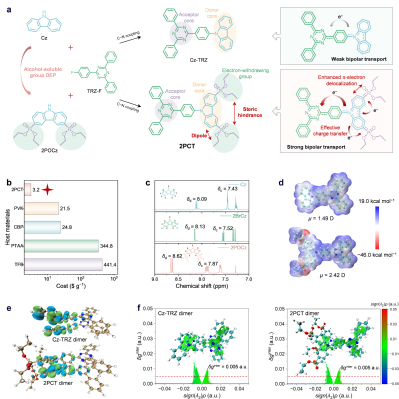
FIGURE 1 | Molecular design, synthesis and theoretical calculation of 2PCT. (a) Design and synthesis of 2PCT and its analogue Cz-TRZ. (b) Cost comparison of 2PCT with conventional host materials in CD-based electroluminescent LEDs. (c) 1H NMR spectra of Cz, 2BrCz, and 2POCz. (d) ESP maps and µ of Cz-TRZ and 2PCT. (e) HOMO distributions of Cz-TRZ dimer and 2PCT dimer. (f) Sign(λ2)ρ colored isosurfaces of δginter = 0.005 a.u. corresponding to the IGMH analysis of Cz TRZ dimer and 2PCT dimer.
Through a strategically designed synthetic route, 2PCT can be prepared in only four synthetic steps, with a total production cost of 3.2 $ g−1, substantially lower than that of conventional host materials used in CD-based LEDs, highlighting its strong potential for commercial application. Both theoretical calculations and experimental results reveal that the incorporation of DEP groups increases the dipole moment of 2PCT and redistributes its electrostatic potential, thereby enhancing the molecular polarity and strengthening hydrogen-bonding interactions with alcohols. As a result, 2PCT exhibits an exceptional solubility in ethanol of up to 273.2 mg mL−1. Furthermore, the DEP groups widen the bandgap of 2PCT, facilitating efficient energy transfer to aqueous/alcohol-soluble CDs. Meanwhile, acting as bulky flexible side chains, the DEP groups effectively suppress intermolecular π–π interactions, enabling the formation of films with an exceptionally low surface roughness (Rq < 1 nm). This provides an ideal host matrix for inhibiting the aggregation of aqueous/alcohol-soluble CDs.
Building on the alcohol-soluble host material 2PCT, the team successfully developed multicolour CD-based LEDs emitting green (G), yellow (Y), and red (R) light, overcoming the longstanding challenge of achieving electroluminescence from aqueous/alcohol-soluble CDs. The resulting G-, Y- and R-LEDs all exhibited outstanding performance with maximum luminances (Lmax) of 8,373, 8,401 and 12,287 cd m−2, respectively and peak current efficiencies (ηmax) of 6.41, 13.04, and 6.73 cd A−1, respectively. Notably, the R-LEDs achieved a record Lmax among all reported red CD-based LEDs, while theY-LEDs exhibited a turn-on voltage of 2.2 V, the lowest value reported to date for CD-based electroluminescent LEDs. Furthermore, leveraging the excellent alcohol processability of 2PCT, the researchers first fabricated large-area Y-LEDs with an emission area of 16 cm2 by blade coating an ethanol solution under ambient conditions. The resulting device exhibited bright, uniform, and stable emission, demonstrating the feasibility of scalable green manufacturing for CD-based electroluminescent LEDs.
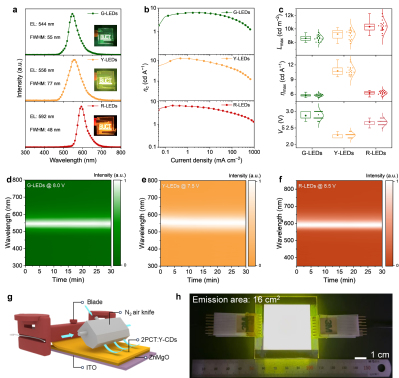
FIGURE 2 | Electroluminescent performance of CD-LEDs. (a) EL spectra of LEDs. The inset presents three photographs of working LEDs. (b) Current efficiency-current density (ηc–J) characteristic curves of LEDs. (c) Lmax, ηmax and Von statistics of LEDs. (d−f) EL spectra of LEDs measured at different times near the Lmax, with applied voltages of 8.0 V (d), 7.5 V (e), and 8.5 V (f), respectively. (g) The schematic diagram of blade-coating preparation of Y-LEDs in ambient air. (h) Y-LEDs in operation with a luminous area of 16 cm2.
In summary, the team developed an alcohol-soluble host material that combines bipolar charge-transport capability with a wide bandgap to meet the requirements of electroluminescent LEDs based on aqueous/alcohol-soluble CDs. The study, entitled “Aqueous/alcohol-soluble carbon dot light-emitting diodes,” was published in Advanced Materials. The first author is Shihao Sha, a PhD candidate at the Advanced Innovation Centre for Soft Matter Science and Engineering, Beijing University of Chemical Technology. The corresponding authors are Associate Professor Runnan Yu from the College of Materials Science and Engineering and Professor Zhan’ao Tan from the Advanced Innovation Centre for Soft Matter Science and Engineering, Beijing University of Chemical Technology. This work was supported by the National Key Research and Development Program of China (2023YFB3611800).
Article information: Shihao Sha, Qirui Hou, Zongzhi Yang, Biao Zhao, Qianglong Lv, Zhuoxu Liu, Yizhao Qing, Huanyu Ma, Chen Zhang, Bing Han, Runnan Yu*, Zhan’aoTan*, Aqueous/alcohol-soluble carbon dot light-emitting diodes. Adv. Mater. 2026, e73773. https://doi.org/10.1002/adma.73773.

