
Light-emitting diodes (LEDs) are central to next-generation energy-efficient lighting and display technologies, creating strong demand for emissive materials that combine high efficiency, low cost, environmental friendliness, and scalable manufacturability. In recent years, lead-free metal halides have attracted broad attention owing to their low toxicity, structural diversity, and excellent photophysical properties. Among them, phosphine-based copper iodide clusters are particularly promising because of their strong emission, heavy-metal-free composition, structural tunability, and high photoluminescence quantum yields. However, their practical application remains hindered by an intrinsic trade-off between scalable synthesis and solution processability. Flexible alkyl chains are often introduced to improve solubility for solution processing, but excessive solubility makes precipitation and purification difficult, increasing material cost. Conversely, materials designed for low-cost scalable production often show poor solubility and film-forming capability, limiting device performance. Therefore, developing a universal strategy that simultaneously enables cost-effective large-scale synthesis and high-quality solution processing is essential for advancing lead-free electroluminescent materials.
Recently, the research group of Prof. Zhan’ao Tan from the BUCT Advanced Innovation Center for Soft Matter Science and Engineering proposed a thermodynamically guided molecular design strategy to resolve this challenge. By rationally regulating the enthalpy change, entropy change, and temperature dependence of the dissolution process, the team realized the coexistence of efficient room-temperature precipitation and high-temperature solution processability. An alkyl-free rigid aromatic bidentate ligand, diphenyl-2-pyridylphosphine (Ph2PPy), was selected to construct the copper iodide cluster (Ph2PPy)3(CuI)2. The absence of alkyl chains reduces the conformational entropy gain during dissolution, while the rigid aromatic structure strengthens intermolecular π-π interactions and modulates solvation enthalpy. As a result, the cluster exhibits moderate and highly temperature-tunable solubility, overcoming the long-standing conflict between scalable synthesis and solution processing.
Guided by this thermodynamic principle, the team achieved kilogram-scale synthesis of through a single-step precipitation process under ambient conditions using acetonitrile as the solvent. The synthesis delivered a near-unity yield of 98.7% without complex ligand synthesis, inert atmosphere protection, or tedious purification procedures. The obtained product showed high purity, excellent reproducibility, and strong operational robustness, with a precursor cost as low as $0.26 per gram. Moreover, the single-step precipitation strategy was successfully extended to other alkyl-free aromatic copper halide clusters, demonstrating its broad applicability and providing a new paradigm for low-cost manufacturing of high-performance lead-free emitters.
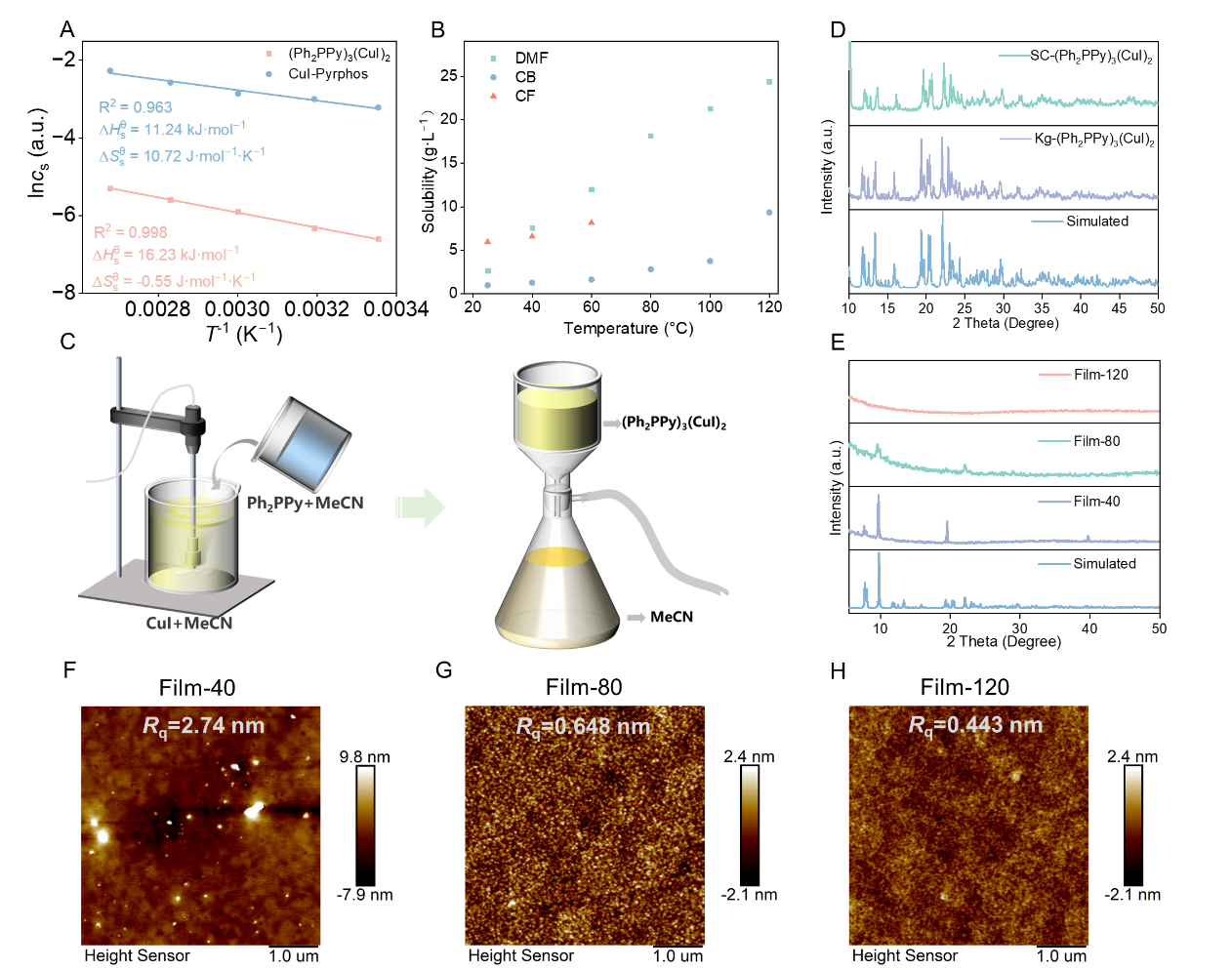
Figure 1. Thermodynamic modulation, kilogram-scale synthesis, and film morphology of (Ph2PPy)3(CuI)2.
On the basis of scalable synthesis, the researchers further developed a hot solution-processing strategy by exploiting the temperature-dependent solubility of the cluster. Through kinetic control of crystal nucleation and growth during film formation, they found that spin-coating at 80 °C enabled a desirable “burst nucleation–slow growth” process, leading to uniform crystalline films with reduced defects and optimized morphology. The resulting films exhibited a high photoluminescence quantum yield of 85.49%. Temperature-dependent time-resolved photoluminescence measurements and theoretical calculations revealed dual-channel emission from phosphorescence and thermally activated delayed fluorescence. The small singlet–triplet energy splitting facilitates reverse intersystem crossing, improving exciton utilization and suppressing nonradiative recombination losses.
Electroluminescent devices based on the optimized (Ph2PPy)3(CuI)2 films achieved outstanding performance under doping-free and solution-processed conditions. The champion device exhibited a maximum external quantum efficiency (EQE) of 21.08% and a maximum luminance (L) of 66,388 cd m-2, representing one of the highest efficiencies reported for doping-free, solution-processed copper halide LEDs. Devices fabricated from kilogram-scale synthesized powders retained nearly identical performance, achieving an EQE of 20.88% and an L of 62,487 cd m-2, confirming the direct applicability of the scalable product in high-performance electroluminescent devices. Furthermore, the team demonstrated 4 cm × 4 cm large-area LEDs with an EQE of 16.47% and an L of 52,063 cd m-2, highlighting the potential of this material system for cost-effective solid-state lighting and large-area optoelectronic applications.
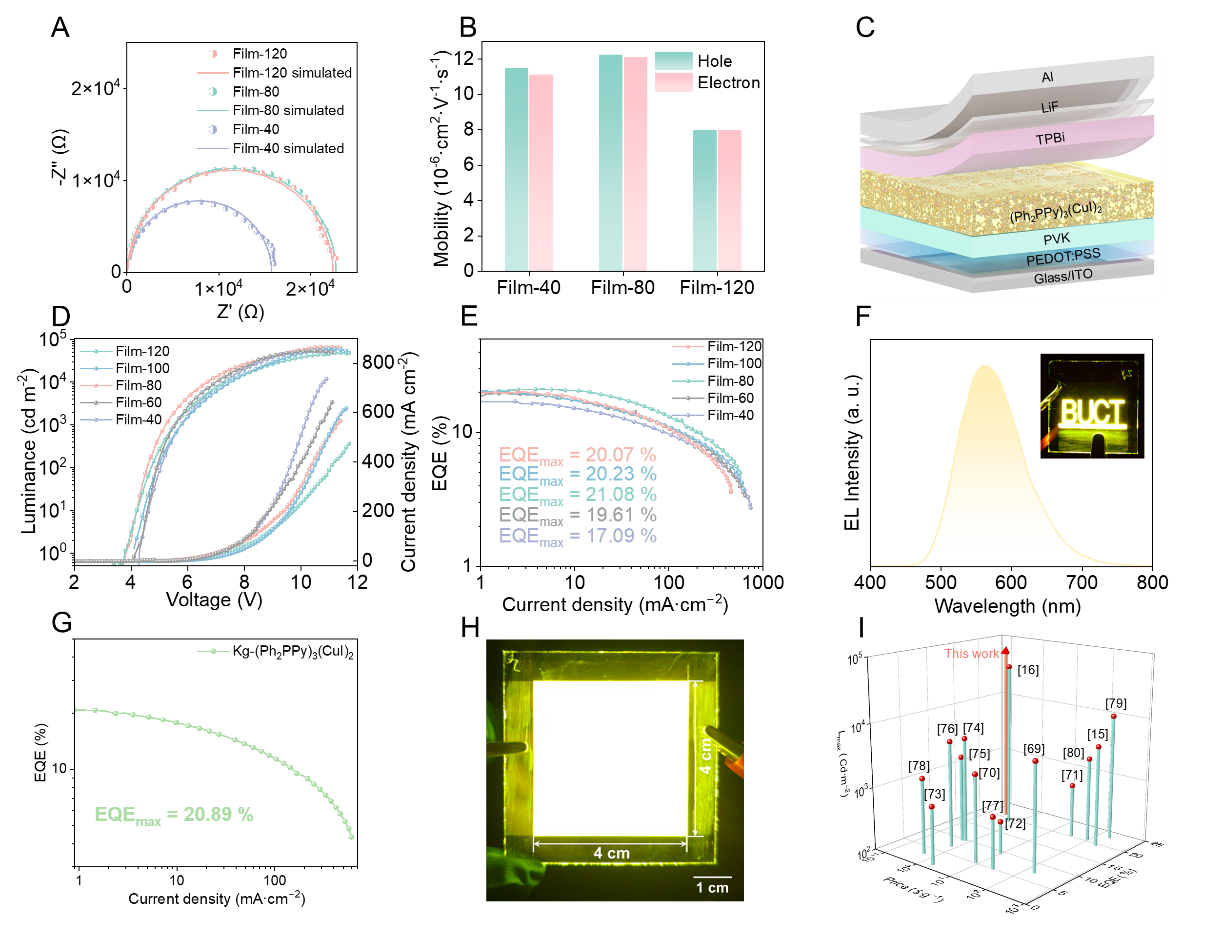
Figure 2. Electrical properties and electroluminescent performance of (Ph2PPy)3(CuI)2 films and devices.
The related work, titled “Thermodynamically guided kilogram-scale precipitation of copper iodide clusters for efficient solution-processed light-emitting diodes,” was published in Science Advances. The first authors are Yizhao Qing and Bing Han, doctoral students from the BUCT Advanced Innovation Center for Soft Matter Science and Engineering. Prof. Zhan’ao Tan and Dr. Biao Zhao are the co-corresponding authors. This research was supported by the Beijing Natural Science Foundation and the State Key Laboratory of Chemical Resource Engineering.
Article Information:
Yizhao Qing, Bing Han, Runnan Yu, Zhuoxu Liu, Peijin Ma, Zongzhi Yang, Haoyu Yuan, Changxiao Li, Shihao Sha, Qirui Hou, Xuejiao Zhou, Biao Zhao*, Zhan’ao Tan*, Thermodynamically guided kilogram-scale precipitation of copper iodide clusters for efficient solution-processed light-emitting diodes. Science Advances. 2026, 12(20): eaef2453.
Original Article Link: https://doi.org/10.1126/sciadv.aef2453

