
Recently, a team led by Professor Liu Yongchun from Beijing University of Chemical Technology has made significant progress in understanding the impact of upper-layer ozone intrusion on ground-level ozone concentrations and secondary aerosol formation. Their findings, titled “Upper-layer ozone intrusion promotes wintertime secondary aerosol formation on the ground,” have been published in the National Science Review (NSR).
This study proposed an objective identification method for upper-layer ozone intrusion (ULOI) events based on surface ozone observations. It analyzed the frequency and spatial distribution characteristics of ULOI events during the winter of 2020 in China, and quantitatively discussed their effects on wintertime ground-level ozone concentrations and secondary aerosol formation in the North China region. The research holds significant importance for deepening the understanding of the causes of compound air pollution in North China during winter. Furthermore, it provides a scalable methodology and framework for assessing the influence of atmospheric vertical exchange on surface atmospheric chemical processes and ecological impacts on a global scale.
Abnormal Diurnal Variation of Ozone:
Ozone is an important air pollutant at ground level, posing risks to human health and ecosystems. Ground-level ozone concentrations typically show a distinct diurnal pattern with a peak at noon due to photochemical reactions, followed by a steady decline to close to zero after sunset due to the stop of photochemical reactions and the loss of O3 via dry deposition and titration by nitric oxide. However, nighttime ozone levels frequently exhibit anomalous increases that cannot be explained by local photochemical processes. This indicates that vertical or horizontal transport plays a significant role in this phenomenon. Yet, effectively identifying such events using ground-based observational data and quantifying their impact on surface atmospheric chemistry remains a challenging issue in the field of atmospheric chemistry.
Identification of Upper-Layer Ozone Intrusion Events:
In this new study, the researchers proposed a simple but robust method for identifying upper-layer ozone intrusion events. Differing from previous research approaches that relied on isotopic analysis or complex chemical transport models, this method identifies downward transport events of upper-layer ozone by ranking the ground-level observational concentrations of ozone recorded during the early morning hours (4:00-6:00) each day over a specific period. An upper-layer ozone intrusion event is identified based on a threshold determined by a sudden change in the rate of change of observed ozone concentration relative to its ranking order. Concentrations above this threshold are classified as upper-layer ozone intrusion events.
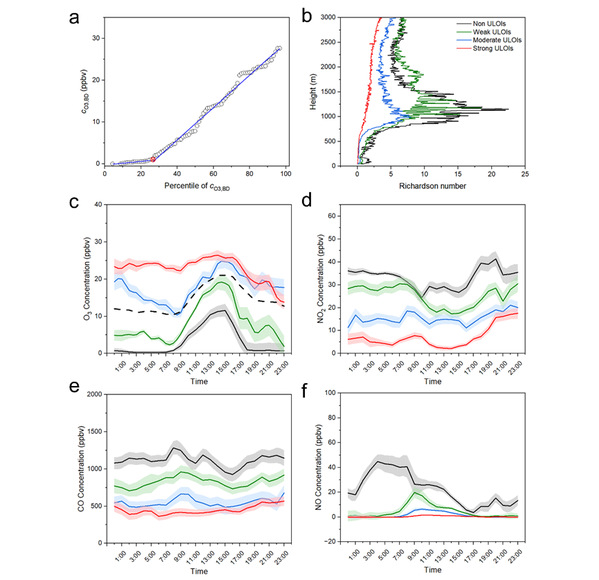
Figure. 1. Overview of the distribution of co3,BD, bulk Richardson number, and diurnal variations of gas pollutants at BUCT station from 1 December 2020 to 28 February 2021. (a) Scatter plot of cO3,BD against its percentiles; red dots indicate the turning point, while blue lines represent linear regressions before and after the turning point. (b) Vertical distribution of the bulk Richardson Number (Ri) with different ULOI intensities[26, 27]. (c), (d), (e), and (f) Diurnal variations of O3, NO2, CO, and NO with different ULOI intensities. The dashed line in (c) represents the diurnal variation of hourly mean O3 during the whole observations. The shaded region around the line represents ±0.2 times the standard deviation.
Impact of Upper-Layer Ozone Intrusion Events:
By analyzing ground-level ozone observation data from across China, the research team found that the occurrence rate of upper-layer ozone intrusion events during the study period ranged between 22% and 74%, more widespread than previously understood. Coastal areas in eastern and southern China exhibited higher frequencies of such events compared to other regions, influenced by meteorological systems such as land-sea breezes, low-level jets, and tropical cyclones. Further analysis revealed that upper-layer ozone intrusion events significantly elevate ground-level ozone concentrations, with nighttime increases of approximately 13-43 ppbv and daytime increases of about 3-14 ppbv. This increases the contribution of the O3 oxidation pathway to sulfate by 50-70% and the fraction of secondary organic aerosol by 2-19% in the North China Plain, highlighting the importance of atmospheric layer interactions and the impact of ULOI events on surface atmospheric chemistry.
The study underscores the significant influence of interactions between different atmospheric layers on ground-level air quality and highlights the crucial role of atmospheric physical processes in comprehensively understanding the mechanisms of ozone pollution and secondary aerosol formation. It emphasizes the necessity of incorporating vertical transport and its effects into future research on ground-level air pollution and air quality management strategies. Given the well-established ground-level air quality monitoring networks in many parts of the world, this research can be extended to other regions to systematically evaluate the impact of such meteorological processes on surface air quality and ecosystems.
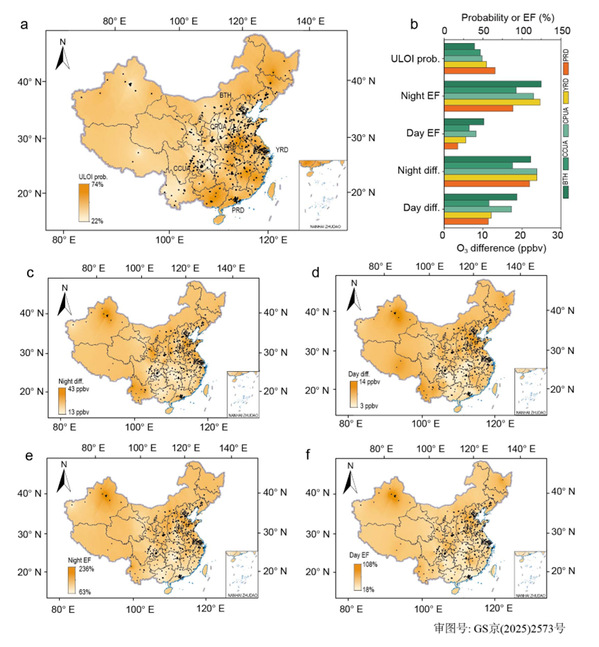
Figure. 2 The spatial distribution of ULOI probability, the difference in O3 concentrations between ULOI and NULOI, and the O3 enhancement factor (EF) across China from December 2020 to February 2021. (a) The spatial distribution of ULOI probability. (b) The ULOI probability, O3 difference, and EF during nighttime and daytime at the main urban agglomerations in China. (c) and (d) The difference in O3 concentrations between ULOI and NULOI during nighttime and daytime. (e) and (f) The EFs of O3 during nighttime and daytime. The black dots in the figures represent the coordinates of the observed sites used here. Beijing-Tianjin-Hebei Urban Agglomeration (BTH), Central Plains Urban Agglomeration (CPUA), Yangtze River Delta Urban Agglomeration (YRD), Pearl River Delta Urban Agglomeration (PRD), and Chengdu-Chongqing Urban Agglomeration (CCUA) are the main urban agglomerations in China.
Highlights:
This study proposes a novel method for identifying upper-layer ozone transport using ground-level observational ozone data. The findings indicate that upper-layer ozone intrusion serves as a significant source of surface ozone in various regions during winter. Such intrusion events can substantially enhance the atmospheric oxidation capacity at ground level. For the first time, the study quantitatively discusses the role of these events in promoting the formation of sulfate and secondary organic aerosols during winter in the North China region.
The first author of the paper is Wang Yuzheng, a doctoral candidate at Beijing University of Chemical Technology. The corresponding authors are Professor Liu Yongchun from Beijing University of Chemical Technology, Professor Quan Jiannong from the China Meteorological Administration, and Professor Douglas R. Worsnop from the University of Helsinki.
This research was supported by the National Key Research and Development Program of China on Integrated Environmental Governance in the Beijing-Tianjin-Hebei Region (Grant No. 2025ZD1204203), the National Natural Science Foundation of China (Grant No. 42275117), the Beijing Natural Science Foundation (Grant No. 8232041), and the Research Open Fund of the China National Environmental Monitoring Centre (Grant on Exposure Measurement of Organic Carbon/Elemental Carbon (OC/EC) in Ambient Fine Particulate Matter).
Link to the original article:
https://academic.oup.com/nsr/advance-article/doi/10.1093/nsr/nwaf593/8405682?login=false

