
Flexible perovskite solar cells (f-PSCs) have demonstrated significant potential in the photovoltaic field due to their high power conversion efficiency and excellent adaptability to various environments, emerging as one of the preferred options for the application of third-generation thin-film solar cells. However, the inherent defects and mechanical brittleness of polycrystalline films pose key challenges. During the thermal treatment of the films, the mismatch in lattice and thermal expansion coefficients between the perovskite and the flexible substrate can easily induce the formation of stress fields within the film. This problem tends to result in macro- or micro-thermal mechanical behaviors in the perovskite film, making it difficult to achieve a balance between photovoltaic performance and mechanical flexibility.
The intrinsic flexibility of perovskite materials (ABX3) stems from the coordination bonds between the A-site cations and the B–X framework. However, the polycrystallinity of perovskite films hinders their intrinsic flexibility. Generally speaking, there are some defects at the grain boundaries in perovskite films, such as charge transport barriers and electron-hole recombination, which all damage the performance of the film solar cells. Grain boundaries are transition zones between crystallites of differing orientation, typically characterized by atomic-scale disorder and incomplete chemical coordination. Additionally, the difference in thermal expansion coefficients between the perovskite and the substrate can cause the perovskite films to undergo tensile or compressive strains. Therefore, the stress borne by the chemical bonds at the grain boundaries is greater than that within the grains, leading to stress concentration and an increase in the modulus within the grains, which increases the tendency for fracture along the grain boundaries. In particular, grain boundaries have become an important limiting factor for the bending and recoverability of thin-film solar cells, restricting their further development. Solving or releasing the stress concentration caused by grain boundaries in perovskite films is an indispensable part of enhancing the flexibility of polycrystalline films. Therefore, understanding the correlation between the micro-structure evolution of perovskite films and their photovoltaic and mechanical properties is an indispensable part of establishing an effective stress regulation mechanism for devices. This has become a key scientific issue for balancing the photovoltaic performance and mechanical flexibility of the devices.
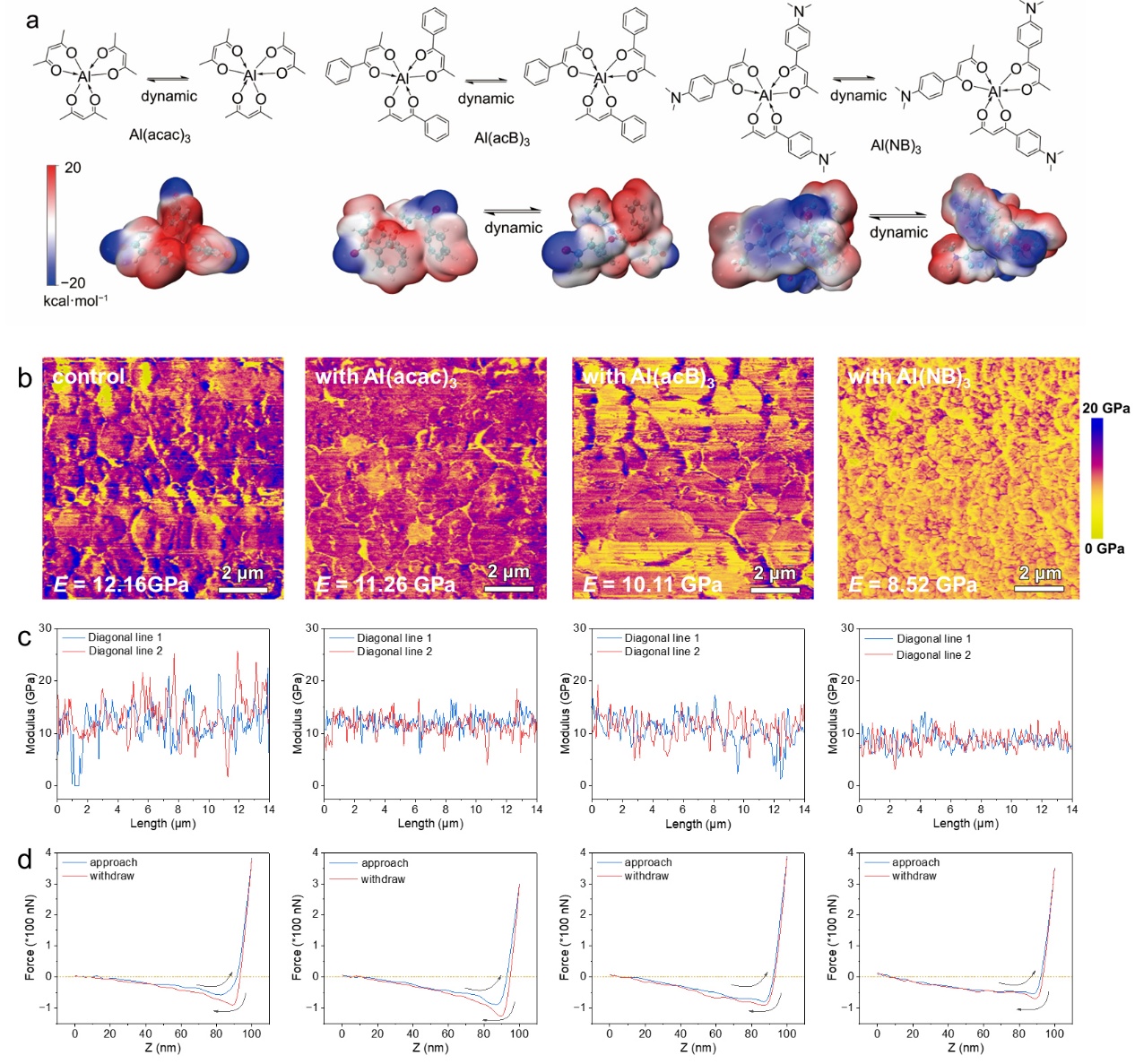
Figure 1: The varying regulation of the Young's modulus of the perovskite film through the metal chelates.
In this study, metal chelates with π-conjugated systems were employed as the lattice regulation medium. Based on the unique multidentate ligand structure and dynamic coordination bonds of these chelates (such as Al(acac)3, Al(acB)3, Al(NB)3), they can selectively anchor at the grain boundaries through electrostatic interactions, thereby building "molecular bridges" between adjacent grains. This not only forms an efficient charge transport channel but also constructs a uniformly distributed tensile strain field through electrostatic interactions, effectively releasing the residual stress within the film and balancing the distribution of Young's modulus within the film. Through the analysis and regulation of the nano-mechanical properties and micro-strain of perovskite films on flexible substrates, the stress and modulus of the perovskite films were ultimately modulated at multiple levels, resulting in the fabrication of a n-i-p structure flexible perovskite solar cell with a power conversion efficiency of 24.47%. Simultaneously, the operational stability and mechanical flexibility of the flexible perovskite solar cell were also improved. This regulation strategy not only focuses on optimizing the nano-mechanical properties of perovskite films but also reveals the intrinsic relationship between the physical properties and mechanical flexibility of perovskite solar cells.
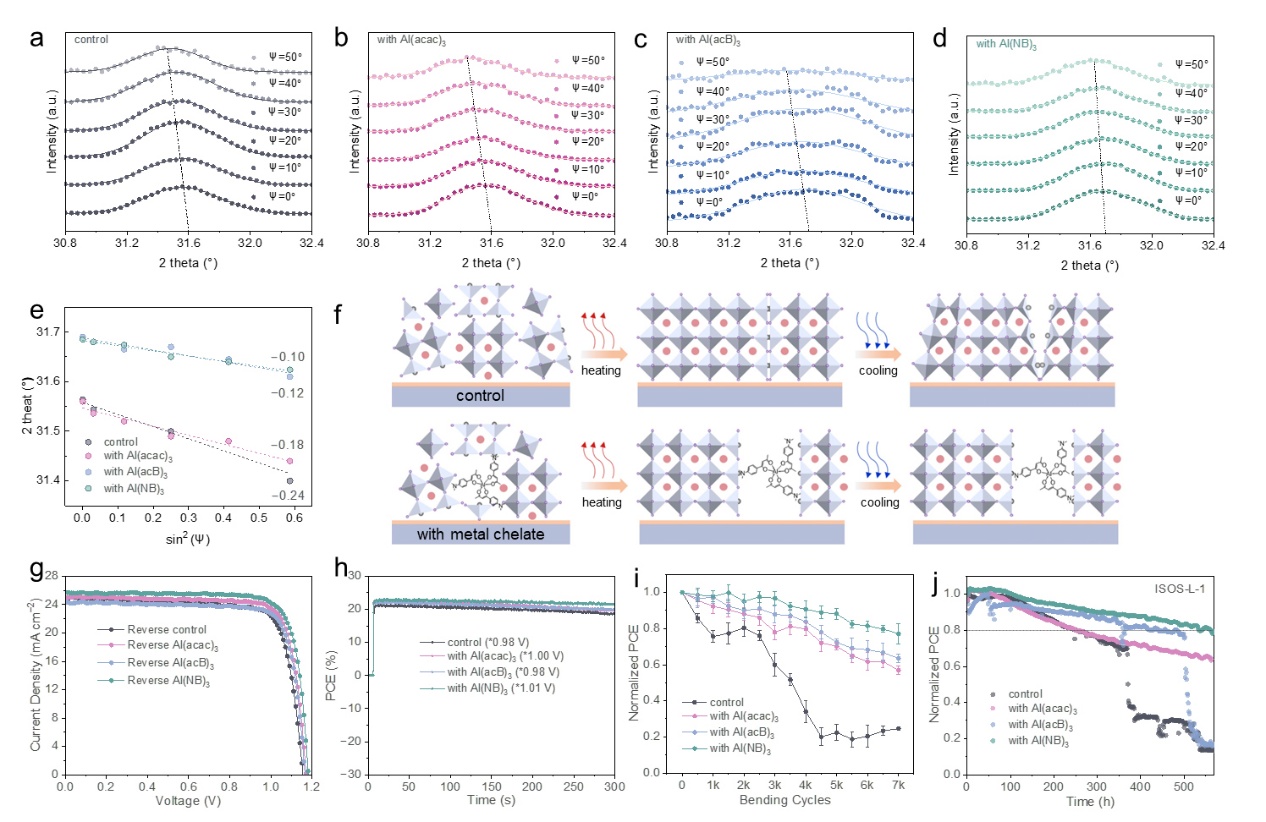
Figure 2: The different degrees ofresidual stress regulation of perovskite films using metal chelates, as well as the photovoltaic and mechanical properties of f-PSCs.
The work is published in the journal Nature Communications under the title "Tensile Strain Regulation via Grain Boundary Buffering for Flexible Perovskite Solar Cells. The first author is Xu Zhiyang, a PhD student candidate at the Center for Beijing Advanced Innovation Center for in Soft Matter Science and Engineering(BAIC-SM), Beijing University of Chemical Technology(BUCT). Corresponding authors are Zhan’ao Tan, Professor at BAIC-SMthe Center for Advanced Innovation in Soft Matter Science and Engineering,, Runnan Yu, Associate Professor at the School of Materials Science and Engineering, BUCTBeijing University of Chemical Technology and Erjun Zhou, Professor at Jiaxing University. This research work project has been supported by the National Key Research and Development Program of China and the National Natural Science Foundation project.
Article information: Zhiyang Xu, Runnan Yu*, Qianglong Lv, Haoran Jia, Qiang Guo, Tangyue Xue, Ruyue Wang, Huaizhi Gao, Erjun Zhou*, Zhan’ao Tan*, Tensile Strain Regulation via Grain Boundary Buffering for Flexible Perovskite Solar Cells. Nature Communications 2025, doi: 10.1038/s41467-025-67027-6
Original article link:https://doi.org/10.1038/s41467-025-67027-6

